

The Vikings offense in 2025 was limited by quarterback injuries and ineffectiveness but the team now has a competition at that position plus an already-strong defense that got major reinforcements in the draft
Scott Smith
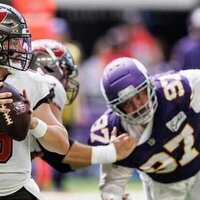
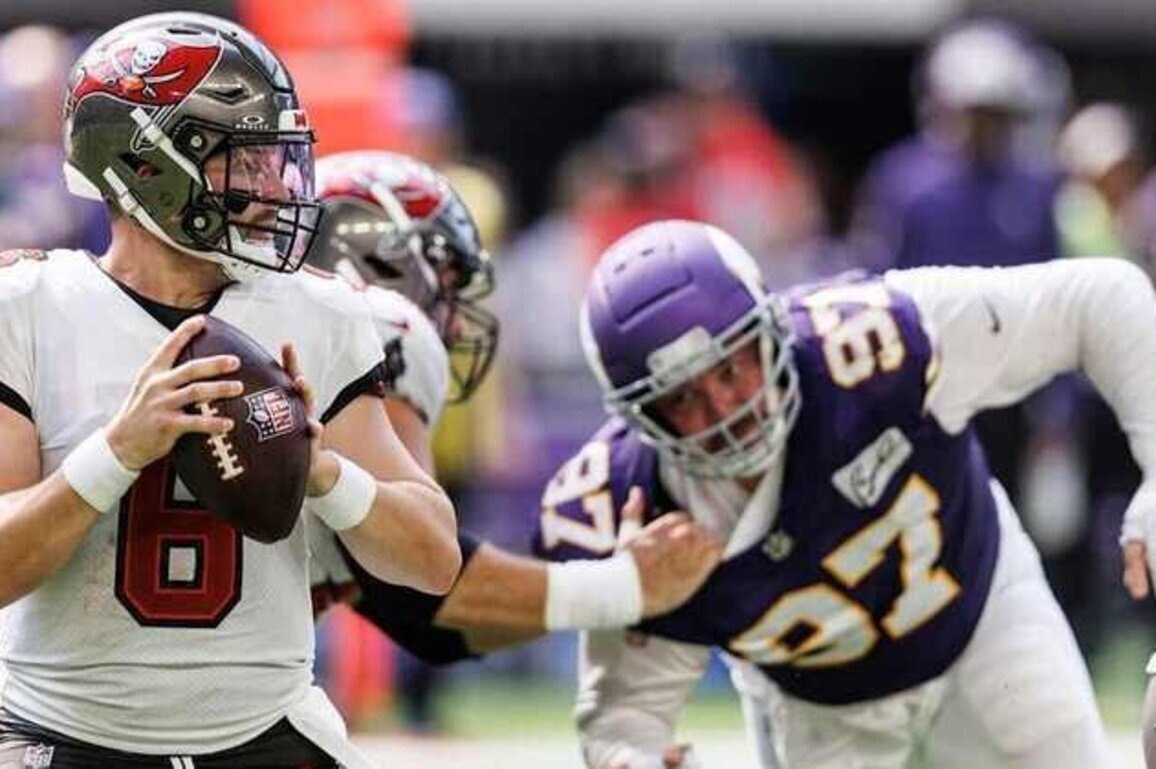
The Tampa Bay Buccaneers will conduct their final OTA practice on Thursday, leaving only next week's mandatory minicamp on the offseason program schedule. While the focus to this point has been on playbook installation and getting all 91 players on the same page so that competition can begin in earnest in training camp, attention soon will turn to the specific challenges the team will face during the 2026 season. As such, with the schedule now laid out, we are taking a closer look at each opponent on the Bucs' schedule, examining what they did last season, which players and coaches have come and gone in the offseason and some as-yet-unanswered questions. Today's focus is on a Minnesota Vikings team that finished last season on a five-game winning streak and has since added a new quarterback who could elevate the offense.
2025 Results
After winning 14 games and securing the number-one playoff seed in the NFC in 2024, the Vikings struggled for much of 2025, losing six of seven games during a midseason stretch to fall to 4-8. Minnesota did rally to finish the season with five consecutive victories for a 9-8 final record, but that was only good for third place in the ultra-competitive NFC North and no playoff berth.
Minnesota did open the season with a rousing 27-24 win over the eventual division champs from Chicago in what was the first career start for quarterback J.J. McCarthy. The Vikings had drafted McCarthy out of Michigan with the 10th overall pick in 2024 but he had missed his rookie season due to a torn meniscus suffered early in the preseason. McCarthy completed 13 of his 20passes against the Bears, threw two touchdown passes and ran for a third score to lead the Vikings back from an 11-point deficit and earn NFC Offensive Player of the Week honors. In December, he had another outstanding outing, completing 16 of 23 passes for 163 yards, three touchdowns and no picks in a 31-0 blanking of Washington. However, he suffered a high ankle sprain in a Week Two loss to Atlanta and missed five games, then later suffered a hairline fracture in his throwing hand and missed another contest in Week 17.
McCarthy and the Vikings' offense had a power outage in November, scoring a total of 42 points during a four-game losing streak that included a 26-0 loss in Seattle. The win over Washington kicked off that five-game run of victories to end the season, a stretch that included a 34-26 win in Dallas and back-to-back home victories over the Lions and Packers.
Overall, McCarthy struggled in his de facto rookie season, throwing 12 interceptions to 11touchdowns, completing just 57.6% of his passes and compiling a 72.6 passer rating, though Minnesota did win six of his 10 starts. Those struggles contributed to star wideout Justin Jefferson finishing with his lowest single-season receiving yardage total, as he hauled in 84passes for 1,048 yards and a career-low two touchdowns. Most notably, Jefferson was able to haul in just 59.6% of his targets, easily the lowest mark of his career. Jordan Addison added 42catches and tight end T.J. Hockenson added 51, but the Minnesota passing attacked ranked 29th in the NFL. Running backs Jordan Mason (758 yards, six touchdowns) and Aaron Jones (548, two) split the backfield load for the league's 23rd-ranked rushing attack.
Led by aggressive coordinator Brian Flores, Minnesota's defense fared better, ranking third in the NFL in yards allowed per game (282.6) and seventh in points allowed per game (19.6). That effort was led by a robust pass rush that produced a 10.96% sacks-per-pass-play rate, second best in the NFL. Second-year edge rusher Dallas Turner produced 8.0 sacks while playing 66% of the defensive snaps and fellow outside linebacker Andrew Van Ginkel added 7.5. The secondary only produced eight interceptions, however, contributing to the team's negative-9 turnover differential, tied for third worst in the NFL. Minnesota's pass defense ranked second in the NFLbut the run defense came in at number 21. Linebackers Blake Cashman and Eric Wilson led the team with 144 and 115 tackles, respectively and Wilson also forced four fumbles.
2026 Arrivals
The Vikings' 14-3 record in 2024 came with quarterback Sam Darnold at the helm of the offense, but Darnold was on a one-year deal and the team didn't re-sign him in the subsequent offseason. He landed in Seattle instead and won a Super Bowl while the Vikings turned things over to their recent draftee, with Carson Wentz backing him up. Not wanting to go into 2026 in a similar situation, Minnesota pounced when the Cardinals cut ties with former first-overall pick Kyler Murray. Murray has 87 games of experience in the NFL and has at times played at an MVP-caliber level, and the Vikings got him for the league minimum because Arizona is still on the hook for most of his salary in 2026.
That was a perfect scenario for the Vikings because they went into this offseason with a very restrictive cap space and that showed in the rest of their moves, or lack of moves. The only other signing of note on offense was former 49ers wide receiver Jauan Jennings, who the team landed after the draft (in which the team did not select any receivers) on just a one-year, $8 million deal. In the draft, the Vikings leaned mostly to defense with their most valuable picks but did land Michigan fullback Max Bredeson in the fifth round. Bredeson wasn't much of a pass-catcher for the Wolverines but he was a rugged and passionate lead blocker.
The Vikings' one notable signing on defense was that of cornerback James Pierre, who had played under several current Minnesota coaches during his first six seasons in the league. Pierre only started 13 games in that span, logging four interceptions, but he is expected to compete for a starting spot as an outside corner in Minnesota alongside the established duo of Byron Murphy and Isaiah Rodgers.
Where the Vikings really reloaded on defense was in the draft, in which they made five picks in the first three rounds and four of them were on that side of the ball. It started at the 18th overall pick with Florida defensive tackle Caleb Banks. Some analysts considered the pick a bit of a gamble due to Banks' history of foot injuries, but there is no doubting his talent when he's on the field. The Vikings doubled up on the position with the first of their three third-round picks, grabbing Iowa State's Domonique Orange. Both linemen are very big men running north of 320; Banks has the higher pass-rush ceiling due to his combination of power and twitchiness, while Orange is more of a run-stopper likely to play the nose.
The Vikings also selected Cincinnati linebacker Jake Golday in the second round, Miami safety Jakobe Thomas in the third round and Stephen F. Austin cornerback Charles Demmings in the fifth round. None of the three may start immediately, especially after the Vikings re-signed Wilson, but the Vikings needed to restock the depth chart, especially in the secondary with Harrison Smith's days in Minnesota potentially at an end.
After Ryan Wright, the Vikings' punter for the past two seasons, left in free agency for a four-year deal in New Orleans, the team turned to a well-known name in Johnny Hekker, who will be playing in his 15th season and for his third different team in the last three years.
2026 Departures
Following the 2025 season, the Vikings ended the four-year run of General Manager Kwesi Adofo-Mensah, perhaps due to some so-so drafts and the way the quarterback position was handled last year. As is customary, the Vikings waited until after the draft to start searching for their successor to Adofo-Mensah. In late May, the team announced that it had hired former Seahawks Assistant General Manager Nolan Teasley.
As noted, Harrison Smith may have wrapped up his impressive 14-year run in Minnesota, and he was released in March with the understanding that he may retire. The move wasn't acrimonious but rather procedural, allowing the Vikings to spread out his remaining cap hit if he does hang up the cleats, though it is believed the team would be open to re-signing him if he chooses to play a 15th season.
Center Ryan Kelly, who played just one season in Minnesota after nine years in Indianapolis, hasalready retired, making that announcement in March after a season in which he suffered three concussions.
Before this year's draft splurge on defensive linemen, the Vikings tried to patch up their D-Line last offseason by signing veterans Jonathan Allen and Javon Hargrave after they were cut by the Commanders and 49ers, respectively. That strategy didn't last long as both Allen and Hargrave were released this March. The overhaul up front also included the trade of edge rusher Jonathan Greenard plus a seventh-round pick to the Eagles for third-round picks in 2026 and 2027. Greenard had just 3.0 sacks in 12 games last year but he had racked up 12.0 in his first year in Minnesota; the trade was likely motivated by the aforementioned salary cap tightness, but it also clears up more playing time for Turner.
The Vikings didn't suffer too many free agency defections otherwise. Third receiver Jalen Nailor, who had 29 catches for 444 yards in 2025, landed a three-year deal with the Raiders for $35 million. After one year in Minnesota, swing tackle Justin Skule returned to the Buccaneers, while running back Ty Chandler left for New Orleans. Chandler only had 47 rushing yards last year but he put up a career-best 461 in 2023. Cornerbacks Jeff Okudah and Fabian Moreau remain unsigned.
Pressing Questions
Will there be an actual quarterback competition in training camp?
The addition of Murray seemed to set up a battle between him and McCarthy for the starting job in 2026, and Head Coach Kevin O'Connell has arranged his OTA practices so that there is no obvious leader in terms of reps. At the combine, O'Connell stressed that this part of the offseason is more about preparation rather than competition. However, reporting out of Minnesota suggests that the more experienced Murray has already taken the lead. It will be telling to see if that is reflected in the rep distribution when training camp begins.
Of course, it is O'Connell and not the reporters who will make this decision, and he isn'tcurrently tipping his hand. He did speak very highly of some of Murray's traits while at the Combine, however, including his ability to make plays on the move. The Vikings were widely considered a playoff contender held back by their quarterback play in 2025, and if Murray shows early that he is the solution to that issue, the competition may not last long.
Can young players step up on the defensive front?
The machinations the Vikings made along their front are noted above. Out are veteran tackles Hargrave and Allen and in are the two highly-touted rookies, Banks and Orange. The trade of Greenard, as also mentioned above, will likely lead to an even larger role for Turner, the 2024 first-round pick the team may be counting on for a breakout season in his third year. Jalen Redmond, a former undrafted free agent in Carolina, spent much of the 2024 season on Minnesota's practice squad but quietly had his own breakout last year with 6.0 sacks. He could join Banks and Orange in the starting lineup.
Minnesota gave up 124.1 rushing yards per game in 2025, ranking 21st in the league (though their 3.99 yards per carry allowed was good for ninth). Will the youth movement up front lead to improvement in that area? Banks' ability to stay healthy will be a significant factor in that effort, as will the continued improvement of Turner and Redmond.